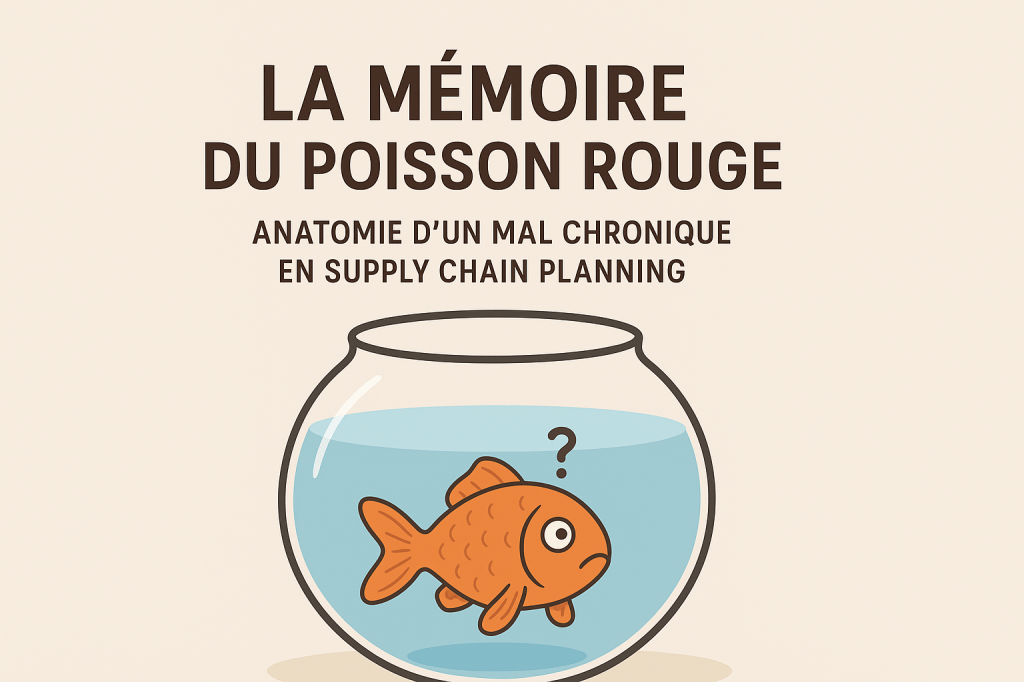
It is amaizing to observe that, in many organizations, strategic and operational gains in Supply Chain Planning often vanish like snow in the sun as soon as a new manager arrives. This is typically valid in supply chain management. I’ve never seen this in quality management for example . Suddenly, this manager seems afflicted by the goldfish syndrome, with a memory regrettably confined to the walls of their own bowl.
Some leaders, obsessed with “making their mark,” rush to reinvent the wheel, overlooking that true managerial power most often lies in the ability to build on what already works—both within and outside the organization.
Modesty is not a weakness; it is the lever of strategic continuity that transforms accumulated experience into tangible competitive advantage.
In the battlefield that is the supply chain, modesty becomes a strategic weapon: it allows organizations to capitalize on historical experience, strengthen critical flows, and deploy resources where they generate maximum impact.
Relearning what has already been mastered is equivalent to launching unnecessary assaults on positions already secured, wasting time and resources that enlightened leaders would instead invest in innovation and the pursuit of new opportunities.
In short, in the relentless game of Supply Chain Planning, only clear-eyed observation, combined with disciplined and humble execution, can turn organizational heritage into lasting competitive advantage and elevate the company into a true logistical powerhouse.
In the war of flows and inventory, reinventing the wheel is not a sign of courage—it is an act of weakness. True conquerors leverage knowledge already gained to move faster, farther, and higher.
There is a striking parallel between nations and large corporations.
They are born out of enthusiasm, grow in an unstructured manner, and often end up becoming stuck in their own certainty. The history of France, built on centralization, is a microcosm of that of many industrial groups: the same desire for control, the same virtues, and sometimes the same dangers.
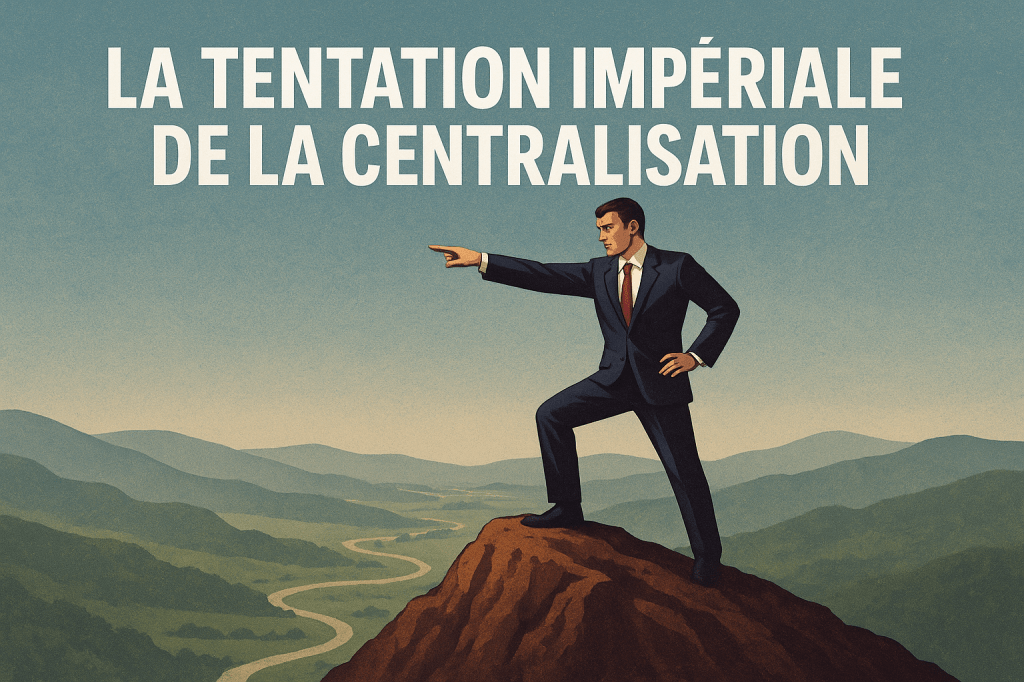
The temptation of corporate Versailles
When a company grows, it naturally seeks to protect itself from disorder.
It creates a headquarters, structures, procedures, and “centers of excellence.”
Everything goes up to the top, everything comes back down through official channels.
It’s a reassuring tendency: it makes us believe we have better control over complexity.
But the risk is an old one: the center, which has become the “corporate Versailles,” begins to think it knows better than those who live the daily reality of the market, the laboratory, or the field.
So, like the kings of France before the Revolution, it surrounds itself with a court of experts, rituals, and dashboards—and ends up no longer hearing the murmurings of reality.
During my professional career, I have had the opportunity to interact with a variety of operational and organizational models:
The balanced model: temperate monarchy
A number of organizations manage to strike the right balance.
Their center is strong, providing vision and ensuring consistency, but local entities retain the freedom to adapt, experiment, and innovate.
It is a form of temperate monarchy, where authority does not stifle creativity.
The headquarters enlightens, guides, and inspires—without stifling.
This type of organization remains consistent without becoming rigid, unified without being uniform.
The secret lies in trust: that of a center that accepts that intelligence is not limited to its walls, and that of the periphery that recognizes the value of a shared vision.
The decentralized model: the republic of provinces
Other companies have opted for a more organic, almost artisanal model.
They prefer local freedom to global symmetry.
Each entity acts as an autonomous workshop, rooted in its territory, responsible for its own choices, but faithful to the same philosophy.
Here, the link between headquarters and sites is not administrative: it is cultural.
This model does not always shine in terms of speed, but it compensates with its human depth and adaptability.
It is the France of cathedrals rather than Versailles: each construction site has its own form, but they all build the same structure.
The hypertrophied model: the temptation of the large center
Finally, after years of diversity, some companies seek to “rationalize.”
They want to harmonize, globalize, and standardize.
The intention is good: to ensure consistency, avoid redundancies, and strengthen the visibility of headquarters.
But by trying too hard to control, they end up sterilizing the organization.
Decisions become slow, creativity dies out, and local teams stop taking risks.
The organization gains in clarity but loses vitality.
It becomes a beautiful machine—but one whose springs are gradually loosening.
It’s the same paradox that great civilizations have experienced:
when the center becomes too perfect, life gradually disappear.
The cycles of power
Here we see the classic cycle of empires, whether political or industrial:
Decentralized expansion: pioneers innovate, disorder is fertile. Centralized structuring: order prevails, rules are established. Bureaucratic rigidity: fear of the unexpected replaces confidence. Crisis or rebirth: depending on the center’s ability to breathe new life into its margins.
Civilizations die when those in power stop listening to their provinces.
Companies decline when headquarters no longer perceives the life of its subsidiaries and factories.
Towards organic centralization
The challenge is not to choose between centralization and autonomy, but to create a dynamic movement between the two.
A center that guides without dominating, that coordinates without controlling.
A center that acts not as a distant brain, but as a heart: it pulses, it connects, it energizes.
The future belongs to organizations capable of combining global rigor with local sensitivity—
those where strategy flows down, but experience flows up.
It is this circulation, not pure verticality, that gives the whole its breathing space.
Conclusion: the respiration of empires
Nations and companies die from the same disease: deafness at the center.
They are reborn when they understand that intelligence is diffuse, that it circulates, that it feeds on exchange.
Centralization, when used in moderation, gives strength.
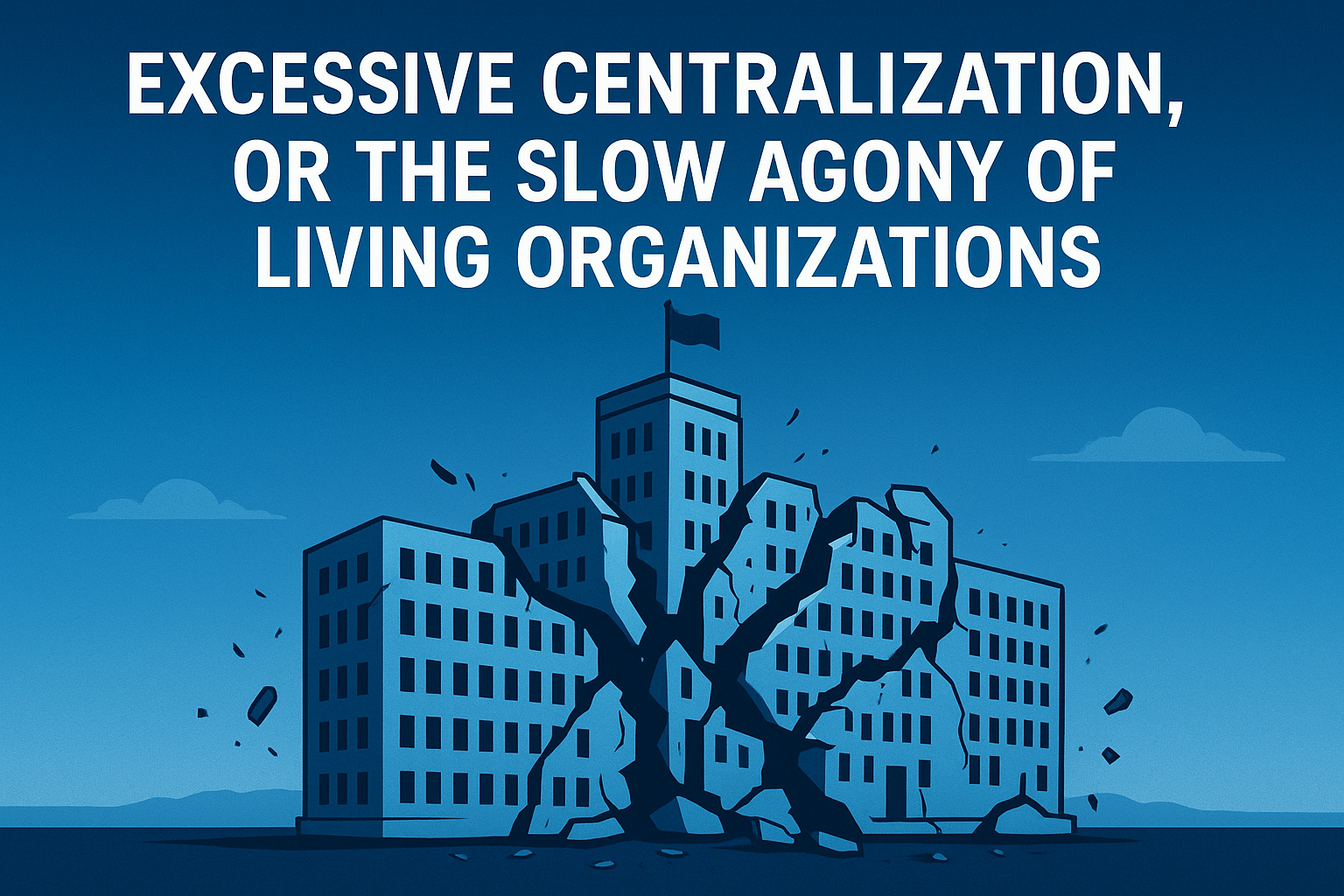
When taken to excess, it becomes a slow suffocation.
An organization, like a civilization, does not last because it controls everything,but because it listens to what makes it alive.
Emmanuel de Ryckel
(Reflections on industrial governance and the dynamics of civilizations)
In the pharmaceutical industry, centralizing supply chain planning functions has gradually become the standard. The goal seemed clear: harmonize processes, improve end-to-end visibility, and enable more coherent capacity decisions on a global scale. This approach has indeed brought real benefits in terms of strategic oversight and coordination between markets and production.
Yet behind this apparent success lies a deeper imbalance. By transferring most planning responsibilities to global entities, local planning functions—particularly at the factory level—have gradually been stripped of their substance. Their role, once central to operational control on site, is often reduced to executing plans decided elsewhere. This gradual shift has led to a loss of autonomy, purpose, and sometimes industrial performance.
How can this trend be reversed?
The Paradox of Centralization
A supply chain can only perform well if each of its links does. Behind every global plan lies a complex industrial reality, full of constraints, uncertainties, and daily trade-offs. Planning truly proves its value on the factory floor, where adaptation and local optimization happen. A strategy only matters if it can be executed rigorously and responsively—directly depending on the skills and autonomy of local teams.
The most advanced organizations understand this: global performance is not built against the field but with it. Global Planning sets the direction, prioritizes, and arbitrates. Local Planning translates this vision into action, optimizing resources and managing performance in close alignment with real-world constraints.
The Critical Role of Local Planning
Revaluing local planning functions means acknowledging their decisive role in supply chain reliability. Local planners ensure stable production plans, anticipate deviations, and adjust sequences according to actual capacity.
They also guarantee continuity of supply to markets and, consequently, the quality of service delivered to customers. In this context, the most relevant metrics are not only internal: Service Level to Customers, days of stockouts, and product availability reflect actual performance far better than OTIF alone, which is often perceived as a logistics metric disconnected from the customer experience.
Restoring Meaning to local  Planning
Putting factory planners back at the center restores purpose to planning itself. These are experts of industrial reality, professionals capable of turning a global vision into reliable execution.
Reestablishing the role of local planning begins with clarifying responsibilities and improving the complementarity between global and local teams. Globally, priorities lie in coordination, strategic alignment, and capacity arbitration between sites. Locally, planning focuses on execution optimization, fine-tuned constraint management, and short- to medium-term control.
For this complementarity to work, a bi-directional model is essential: local teams don’t just execute global decisions—they feed global planning with reliable data, highlight constraints, and propose trade-offs. Regular feedback loops—such as weekly reviews of local constraints with Global Planning—turn these interactions into real performance levers.
At the same time, it is crucial to build a rewarding career path for local planners. Clear career progression enables them to evolve into recognized expert roles, such as “Site Planning Master” or “Local Supply Chain Optimization Lead.”
Creating a cross-functional network of planning experts, visible and valued alongside global functions, further reinforces their recognition. Finally, highlighting local gains achieved through optimization initiatives—Lean Planning, automation, simulations—demonstrates the strategic impact of these teams on overall performance.
Global Excellence Starts in the factories
Global excellence is not commanded from headquarters. It is built every day—on the shop floor, in planning offices, close to operations. Local planners are the discreet artisans of this excellence: embodying rigor, responsiveness, and resilience that distinguish a well-managed supply chain from a truly high-performing one.
By placing local planning at the heart of operations, companies strengthen agility, coherence, and their ability to respond effectively to market needs.
It is in this alliance between global vision and local excellence that the true competitiveness of the supply chain is decided.
How are you empowering local planning functions in your organization?