Qu’est-ce qui a vraiment changé dans le domaine de la planification industrielle ces 50 dernières années, sinon le fait que chaque avancée technologique et chaque élargissement du champ d’application, a donné lieu à de nouveaux acronymes et à des tentatives purement Commerciales et Marketing des entreprises de Conseil et de fournisseur de systèmes, visant à rendre « ringard » ce qui avait été fait auparavant.
Cependant, quel que soit le système, rien ne pourra jamais remplacer la pertinence de l’approche en trois niveaux, ce que j’appelle la méthode de l’entonnoir (S&OP/RCCP, MPS, Shop Floor Scheduling) développée durant l’invention du principe MRP2. Ce qui rend le MRP2 si important et pénalise ceux qui sont attachés à l’histoire de la planification industrielle, c’est que cette abréviation de trois lettres représente à la fois un système de calcul informatique et une méthode de planification industrielle d’une logique infaillible.
L’intérêt de cette approche, déjà préconisée à l’époque, était de débuter par une analyse macroscopique approfondie de la demande à long terme ainsi que des possibilités du réseau industriel d’y répondre (S&OP). En prenant du recul grâce à cette vision globale de la chaîne d’approvisionnement, il était possible d’anticiper les problèmes majeurs et de prendre des décisions éclairées. Cette perspective panoramique locale ou globale de la chaîne d’approvisionnement a également permis aux entreprises, depuis cette époque lointaine, de réduire l’écart entre leur stratégie et leurs objectifs opérationnels quotidiens. Une véritable opportunité pour aligner les décisions quotidiennes avec les objectifs à long terme.
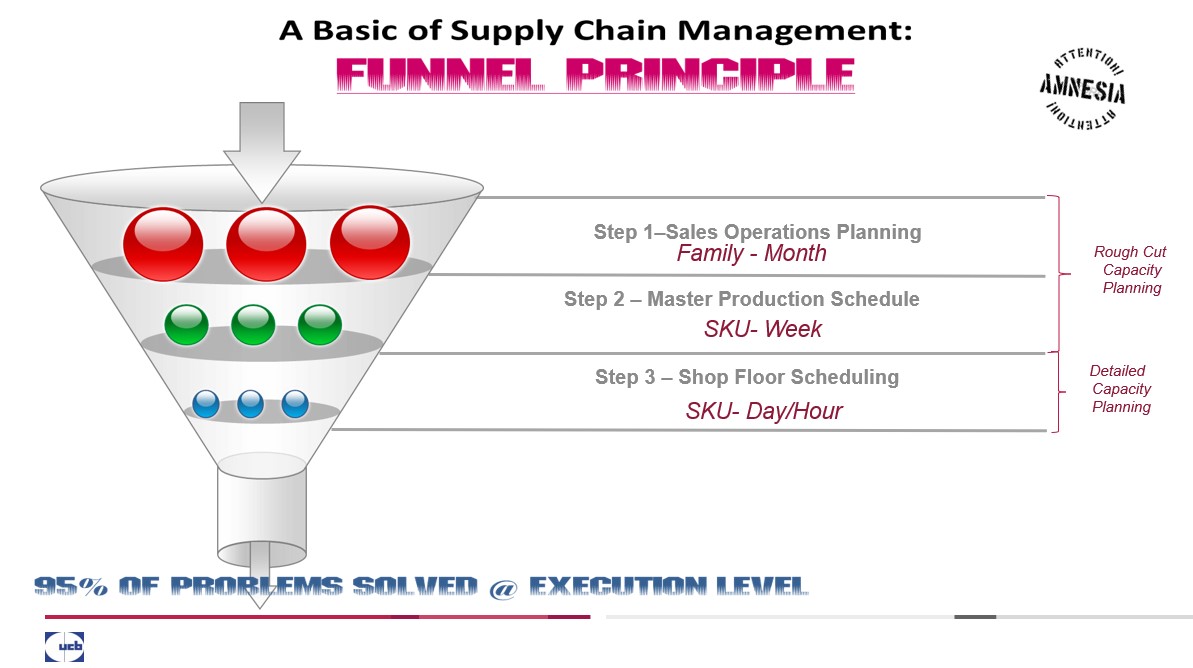
La logique nous dictait alors de nous concentrer sur un horizon plus restreint, à savoir le court et moyen terme, afin de planifier plus en détail les décisions prises lors du processus S&OP. Cette approche nous permet a ce stade de déjà prendre des engagements fermes envers nos clients. Pour ce faire, il essentiel de vérifier avec précision la disponibilité de nos capacités industrielles ainsi que des matières premières.
Vient enfin le temps de la préparation de l’exécution à très court terme, avec l’ordonnancement fin, l’allocation des matières voir du personnel sur les équipements.
En réalité ce qui a changé depuis 50 ans, est qu’après le système Mrp 2 au départ s’adressait à une composante seulement de l’entreprise, la planification de la production et des approvisionnements matières ; ce n’est que fin des années 90 qu’apparurent les ERP , et la prise en compte dans un même système de la totalité des composantes de l’entreprise. Que n’ai-je entendu à l’époque sur le triste destin du MRP2 et de sa puissante philosophie?
Puis vers la fin du XX ème siècle vint l’heure des APS, Systèmes de planification avancés qui bénéficiant de foudroyant progrès technologiques permettaient d’élargir le périmètre de la panification à une Supply Chain de plus en plus globale et étendue sur le territoire de la planète. La vitesse d’exécution et la puissance des “Solvers” offrirent ainsi de nouvelles possibilités insoupçonnées, mais était-ce là suffisant ? Sans l’intelligence d’une méthodologie approfondie pour analyser les milliers de données fournies par ces nouveaux engins, sans des protocoles de travail bien établis pour la prise de décisions et leur répercussion sur l’ensemble de la chaîne, la technologie ne sera jamais qu’un facteur d’instabilité supplémentaire.
Les mêmes stratèges de la communication et du Marketing dont il fut question en introduction ont à chaque pas en avant, cherché à dévaloriser les mots anciens , créant ainsi de nouveaux acronymes dont on a rapidement compris qu’ils ne faisaient qu’ajouter une couche superficielle de vernis, masquant avec peine le vieux principe déjà validé depuis de nombreuses années. Par exemple, le vieux S&OP du siècle dernier s’en est finalement assez bien sorti, même s’il a été partiellement éclipsé par l’BP ou d’autres abréviations.
Pure vantardise du progrès !!
En réalité, la véritable évolution de l’histoire du S&OP a résidé en l’extension de son champ d’application, passant d’un simple site à l’ensemble d’un réseau industriel et élargissant ses thèmes à des aspects plus financiers. Il est important de reconnaître de manière raisonnable que dans ce cas, le progrès technologique lié aux systèmes n’a fait que répondre aux besoins croissants du business et non l’inverse. C’est une évolution naturelle qui démontre l’adaptabilité de S&OP aux exigences de plus en plus complexes de l’industrie.
Le MPS quant à lui à davantage souffert et a souvent disparu derrière une « planification opérationnelle » sans que l’on ne sache très bien si elle couvre aussi l’ordonnancement a très court terme (SFS, Shop Floor Scheduling).
Qu’importe en fin de compte comment on l’appelle, il est crucial dans le domaine de la planification industrielle de pouvoir disposer d’une phase de mise en œuvre des décisions prises en S&OP, que ce soit en termes de demande ou d’approvisionnement. C’est donc l’heure, quel que soit le système utilisé, d’affiner notre vision des programmes de demande et d’approvisionnement à moyen et court terme, de les stabiliser afin de pouvoir prendre des engagements fermes envers nos clients, puis de gérer par exception les changements qui ne manqueront pas d’intervenir dans cette zone dite « ferme ».
En conclusion, je recommanderai vivement à tous les fervents de la “ringardisation” du passé, de plutôt mettre en valeur leur créativité et leur intelligence pour résoudre les problèmes qui entravent la chaîne d’approvisionnement, le service client, et les coûts de l’entreprise, plutôt que de s’engager dans cette bataille stérile d’une prétendue modernité dénuée d’intérêt fondamental.
Emmanuel de Ryckel
#supplychainplanning #erp #mrp2 #sap #apo #omp #i2
SUPPLY CHAIN PLANNING THE GAME OF LABELS OR THE FALSE PROMISES OF PROGRESS
What has really changed in the area of industrial planning over the last 50 years, except the fact that every technological leapfrog and every extension of the Supply Chain scope has given birth to new acronyms and to purely commercial and marketing maneuvers by consultancy firms and systems vendors, with the only goal of outdating what had gone before..
However, whatever the system is , nothing will ever replace the relevance of the three-level approach, what I called yesterday the “funnel method” (S&OP/RCCP, MPS, Shop Floor Scheduling) developed during the invention of the MRP2 principle. What makes MRP2 so important, and what penalizes those who are attached to the history of industrial planning, is that this three-letter abbreviation represents both a computer calculation system, and an indestructible logical method of approaching industrial planning.
The advantage of this methodology at the time, was that it recommended to start with an in-depth macroscopic analysis of long-term demand, and the ability of the industrial network to meet it (S&OP). Taking a step back with this global view of the supply chain, made it possible to anticipate major problems and take appropriated decisions.
This local or global panoramic view of the supply chain has also enabled companies, since those distant days, to reduce the gap between their strategy and their day-to-day operational objectives. S&OP, a real opportunity to align day-to-day decisions with long-term objectives.
Logic dictated that we should in a next step, focus on a more limited timeframe, namely the short and medium term, so that we could integrate in the future execution plan, the decisions taken during the S&OP process. At this stage, this approach enables us to make firm commitments to the customers, after verification of the industrial capacity and the raw materials that are really available to make these promises.
Ultimately comes the time to plan for the very short-term execution, with fine-tuned scheduling, allocation of materials and even personnel on the equipment.
What has changed over the last 50 years is that the MRP2 system was initially aimed at just one component of the company, Production, and material supply planning; it wasn’t until the end of the 90s that ERP appeared, when all the company’s components started to be considered in the same system.
Apart from that, the learning from MRP2 certainly didn’t deserve “to be thrown out with the bathwater together with that baby”.
Then came the APS (Advanced Planning Systems) times, which thanks to extraordinary technological progress, have allowed the expansion of the Supply Chain scope to a much larger scale, every day more global. The speed of execution and power of the ‘Solvers’ offered unsuspected new possibilities, but was that enough?
Without the intelligence of a real operating method for analyzing the thousands of data supplied by these new machines, plus well-established working protocols for taking decisions and passing them on throughout the chain, technology will never be anything more than an accelerator of chaos.
The same communication and marketing strategists mentioned in the introduction have, at every step forward, tried to undermine the value of the old words and principles , creating new acronyms which soon appeared, as just superficial layer of varnish, barely masking the old principle which had already been successful for many years. For example, the old S&OP of the last century has finally survived quite well, even if it has been partially eclipsed by BP or other abbreviations.
False boasts about progress!

In fact, the real evolution in the history of S&OP has been the extension of its scope from a single site to an entire industrial network and the extension of its themes to more financial aspects. It is important to recognize in a reasonable way that in this case, the technological progress linked to the systems has simply responded to the growing needs of the business and not the other way round. This is a natural evolution which demonstrates the adaptability of S&OP to the increasingly complex requirements of industry.
The MPS, has suffered more, and has often disappeared behind ‘operational planning’ or other acronyms. I’ve even heard specialists telling me that it was completed out of date.
For my part, I am firmly convinced that there will always be a need in a planning cycle for a key phase during which, over a shorter timeframe and at a finer level of granularity, the planner will use the alerts from his system to confirm the feasibility of a plan that will enable firm commitments to be made to customers.
In conclusion, I would strongly recommend that all those who are keen to ‘old-fashionedise’ the past should preferably use their creativity and intelligence to solve the problems that are impeding the supply chain, customer service and business costs, rather than engaging us in this sterile battle of so-called modernity, which is without any fundamental interest.
Emmanuel de Ryckel
 TRANSITION MANAGEMENT IN SUPPLY CHAIN
Leave a comment