Regarding the acceptance of lean thinking, Dr. Shigeo Shingo, one of the founders of the Lean philosophy in Japan, invented one day a parable, in his book “ZERO STOCK PRODUCTION “to describe how it could be difficult for people to accept changes in their organization.
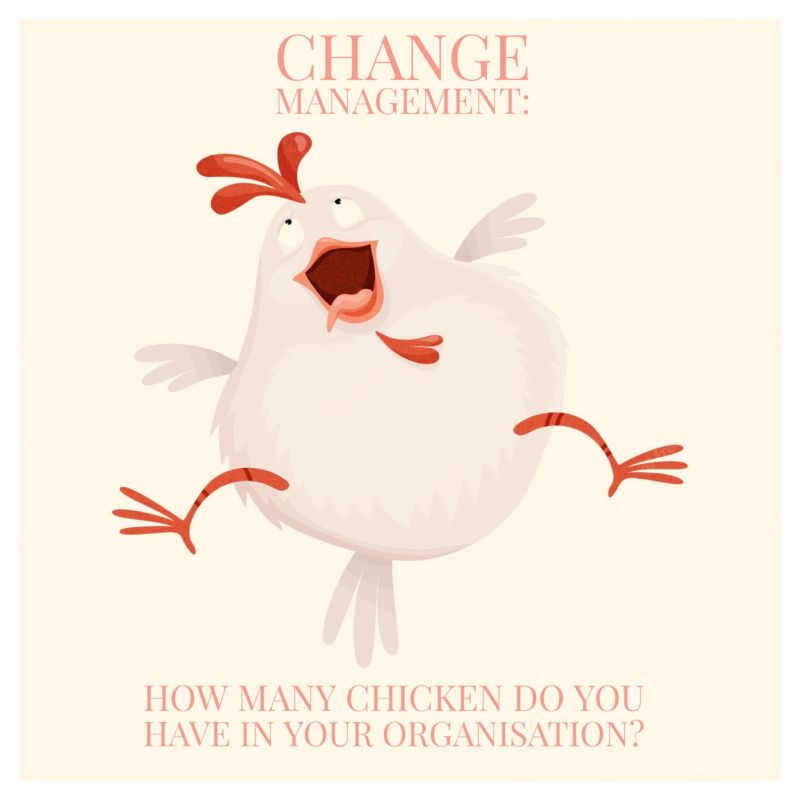
This one was named the “Story of the Chimpanzee”, but Shiego Shingo called it the “Story of the Chicken” for reasons that will become apparent in a moment.
According to Shingo, a science experiment was conducted to determine the relative learning rates of different characters.
For this experience, the scientist took a chimpanzee, a dog, a little kid and a chicken.
The 1st part of the experiment carried was the following.
He took as many cages as there were individuals.
The experiment consisted of placing food (of course appropriate for each “guinea pig”), outside the cage but within easy reach.
A very important element to understand this experience, is that the door at the back of each cage was purposely left fully opened since the beginning!
The idea was that everyone could simply reach the food located outside the cage by passing his hand, his beak, or his snout through the bars.
The operation was repeated in this way dozens of times to create habits among the various characters.
He repeated the operation dozens of times and, each time, the different characters had no trouble helping themselves and reaching the food.
Suddenly, he changed one of the parameters of the experiment: The door at the back remained open, but from that moment on, he moved the food out of the reach for each of the actor.
A time measurement was taken for each participant to determine how long each one would take to find the unlatched door and retrieve the food.
The chimpanzee was the fastest to find a way to the food, making a hasty exit to his lunch.
Behind the chimp was the kid, who checking the cage perimeter, soon found the unlatched door.
Next came the dog, not as fast as the kid, but nevertheless clever enough to discover the way out.
But the crucial point is: WHAT HAPPENED WITH THE CHICKEN?
This animal’s destiny was so tragic that I find it hard to talk about it without feeling sad.
As the others, the chicken proceeded to the end of the cage nearest to the food and proceeded to peck in the direction of the food.
The poor animal was unable to cope with the situation, and never moved from that spot.
Never thinking of turning around to see that the door was open, became desperately exhausted, strangled, and died in horrible conditions.
Then came my question:
“Do we have chicken in our organization?” or “Have you ever been a chicken in your job?” or “How many chicken do we have around us in our organization?”
How many people do you have in your network, that were totally unable to realize that the world around them was changing, that or the competitor was doing something better…
I’d like to finish this drama on a humorous note.
I will never forget this young guy, member the Supply Chain team of a big pharma, who laughingly told his colleagues as he left our training course; “can you believe it, Manu just called me a chicken!!!”.
Emmanuel de Ryckel
 TRANSITION MANAGEMENT IN SUPPLY CHAIN
Leave a comment