When I embarked on the Henri Salvador do Brasil project, financial returns were never the objective.
I am neither a professional music producer nor a musician. I never expected to make a living from an album. My ambition was different: to challenge myself, enjoy the journey, and test whether the skills, methodologies, and strategic thinking I had accumulated throughout my professional career could be applied to a project of this scale and complexity.
Over the years, both in industry and during my business studies, I learned a simple lesson: the success of a project is never determined solely by the quality of the product. Success depends equally on understanding the audience and creating the right conditions for engagement.
From the outset, I knew that Henri Salvador do Brasil could not simply be a tribute album. Its real challenge was to introduce Henri Salvador to a new generation.
Years earlier, while managing a concert venue in Brussels, I had noticed that audiences attending Brazilian music performances were remarkably young. I observed the same phenomenon in Paris and elsewhere while attending concerts by Marcos Valle. Brazilian music continued to attract listeners aged 25 to 35—many of whom had never heard of Henri Salvador.
This led me to identify three distinct target audiences.
The first consisted of those who had grown up listening to Henri Salvador and had known his songs since childhood.
The second included listeners aged 40 to 60 who rediscovered him through the extraordinary success of Chambre avec Vue in the early 2000s.
The third—and strategically the most important—was a younger audience attracted to contemporary Brazilian music but largely unfamiliar with Henri Salvador’s legacy.
At that moment, what had initially been an intuition became a marketing strategy.
I believed that Marcos Valle’s talent, credibility, and enduring relevance could serve as a bridge between these audiences. Marcos was not simply the ideal musical director; he became the connector between a timeless repertoire and a new generation of listeners.
This conviction led to a decision that occasionally surprised people: throughout the project’s communication strategy, I deliberately gave Marcos Valle equal prominence to Henri Salvador.
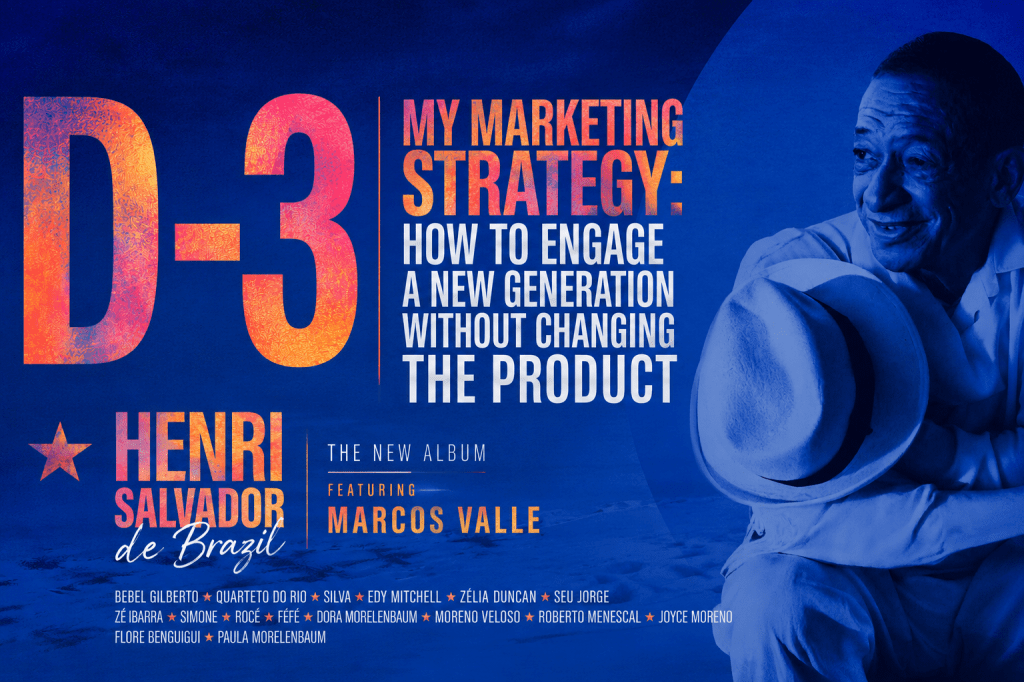
The same strategic thinking influenced the album artwork. I wanted a visual identity that felt contemporary, vibrant, and aspirational—something capable of resonating with a 30-year-old streaming subscriber as much as with a dedicated vinyl collector.
The design was heavily inspired by the iconic Blue Note covers, whose graphic sophistication and timeless appeal I have long admired. My objective was not to create another promotional product. I wanted to create an object with lasting value—an album that could remain relevant on streaming platforms, in record stores, and in personal collections for years to come.
Ultimately, the marketing strategy behind Henri Salvador do Brasil was built around a simple principle: do not change the product—expand the audience.
If this project enables a new generation to discover Henri Salvador for the first time, then the objective will have been achieved.
Emmanuel de Ryckel


Leave a Reply